@ART.HUR.FRAIN//
Arthur Frain
Sometimes pretty pictures, usually a cesspool of words, and always dripping with feelings.BA (Hons) Contemporary Art PracticeContemporary creator based in Aberdeen, Scotland.
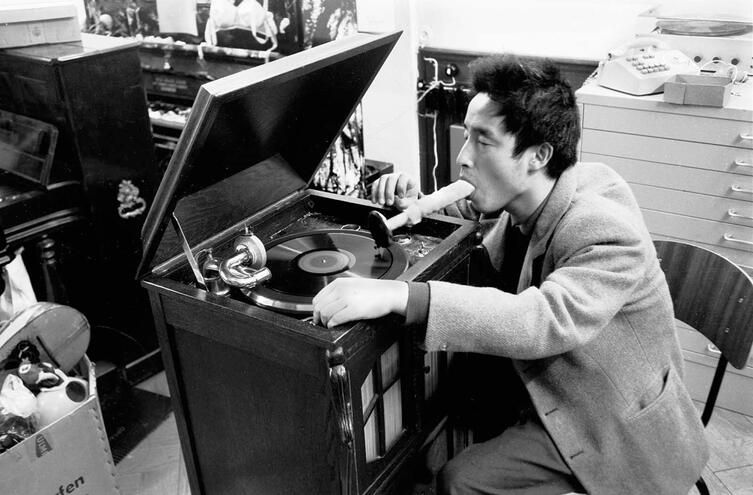
‘I DO NOT REGRET’.
Nam June Paik was a South Korean artist born in 1932 who worked mostly in the USA. With a background in music, philosophy, history and robotics, he is known as "the father of video art".Paik used new technology and took what was considered an unconventional approach towards technology at the time to create his artworks. Inspired by John Cage and a member of the Fluxus movement, Nam June Paik wanted to humanise technology and make information available to all through a global connection without boundaries.This idea is reality for us today, with the internet and social media at the forefront of how information is shared.
Tv Bra For Living Sculpture - 1969
Worn by Charlotte Moorman
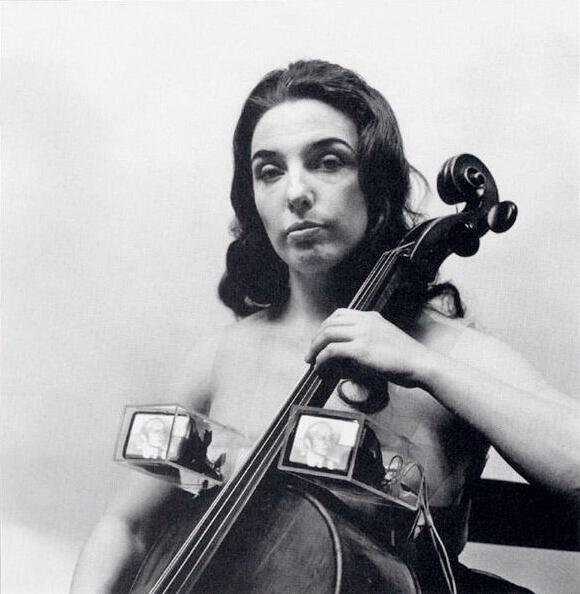
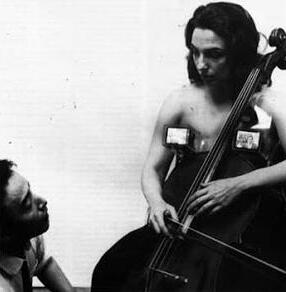
Nam June Paik often used televisions and radios, among other technologies, in his artwork. He was known for manipulating the image and sounds that these devices produced.In "TV Bra For Living Sculpture" Paik collaborated with Charlotte Moorman, an Avant-Garde cellist. Moorman wore functioning televisions on her torso as a bra whilst she performed a musical score to an audience, the bra and score were created by Paik.The TV Bra played recorded video, live television and a live CCTV feed of the audience. Through this collaboration, the belief that art and technology play an important role in human connectivity was emphasised.The work was difficult for the public to view and understand or take seriously as artwork. In videos of the performance we can hear audience members wolf whistling and heckling Charlotte Moorman. In one instance, she was even arrested for indecent exposure.
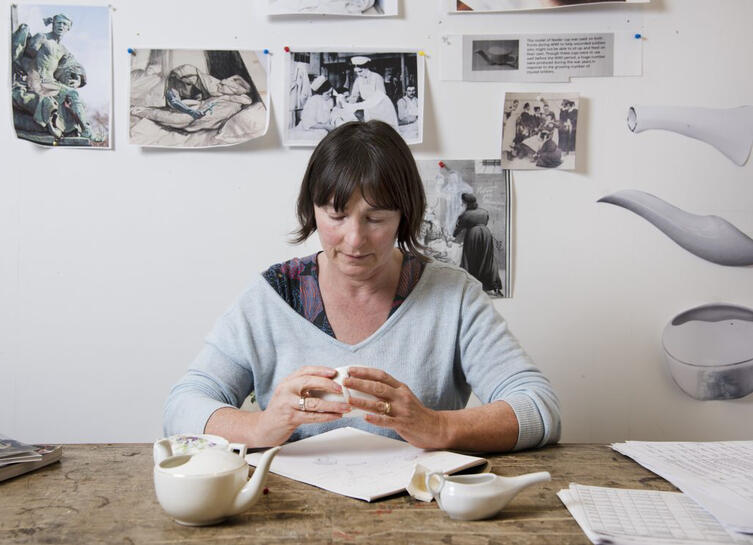
CHRISTINE BORLAND
Christine Borland is a Scottish artist born in 1965. She has worked with sculpture, instillation and site specific art. The theme of our exhibition is controversial work i.e. works that challenge the conventional ideas of art. I chose to look at showcasing Christine Borland in this exhibition due to her works commentary on society’s treatment of people as well as the morality of this. All of our artists link to each other in that they challenged one or more social conventions in art boreland dose this through commentating on the things about humanity and society’s treatment of humans that is monstrous.
THE PHANTOM TWINS
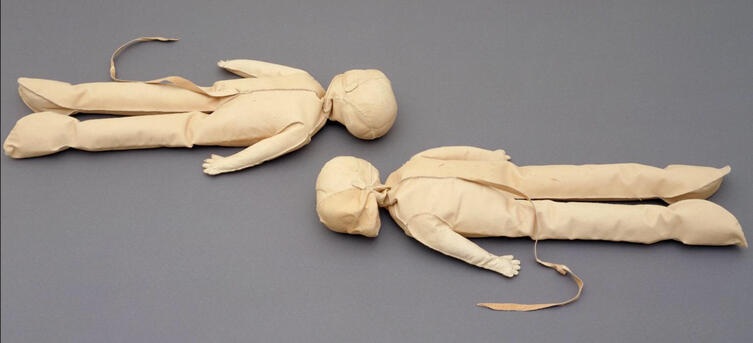
The twins was first shown in frac Languedoc rousillion the context for this was for the literary presentation of Mary Shelley’s Frankenstein. Borelands work relates to that of Frankenstein due to it to reflecting the creation of Frankenstein as both subject matters are creations of proxy life forms as well as in both subjects reuse of human remains to recreate an artificial representation of human life. An example of Borelands work that challenges social conventions is that of phantom twin a sculpture made in 1997 based on a childbirth demonstrative model that was used by William smellie a Scottish obstetrician in the 18th century. Whilst the model it is based on uses a real skull borelands sculpture uses a plastic one. Borelands choice to recreate the model without making it an exact replica by forgoing the use of a real skull highlights her opinion on the two sides of a coin that can be evidence in the morality of using a real human skull in such a model even if the model is being used in a positive way i.e. to educate people on childbirth. Borelands foregoing of this material expresses a moral judgement on making an object or tool out of a part of human being as in becoming a tool as well as an object it is negating the autonomy of the individual who was made into an object. I have found borelands work to frequently be controversial due to borelands works targeting and questioning the issues of morality and the way humans are treated by social systems. Specifically in this example boreland is questioning the way in which the children’s body’s had became a perversion of the desire to create new life and where then used to explain the creation of new life to others.
FRANKO B
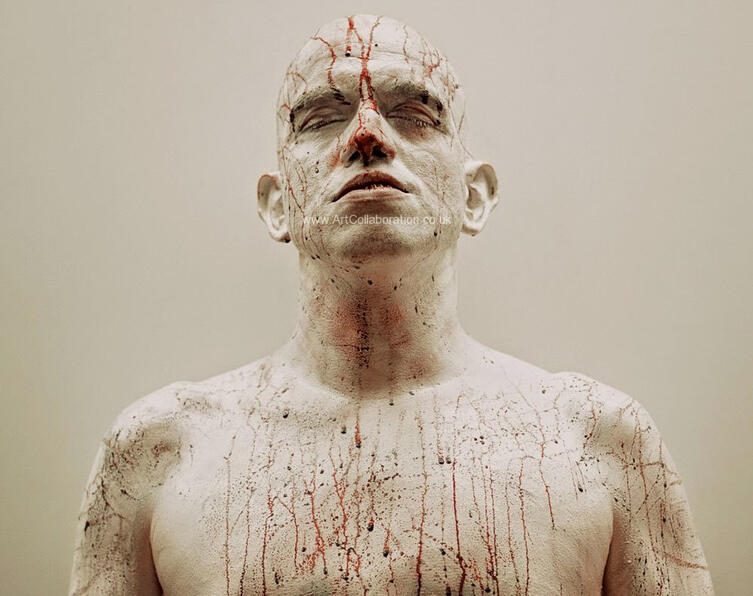
Franko B is an extraordinary, internationally acclaimed artist who has been making performances, drawings, installations, and sculptures for over 30 years. He lives and works in London and is Professor of Sculpture at l’Accademia Albertina di Bella Arti di Torino. His work explores themes such as pain, eroticism, revulsion, ecstasy and masculinity, and usually involve his own body.
DON’T LEAVE ME THIS WAY
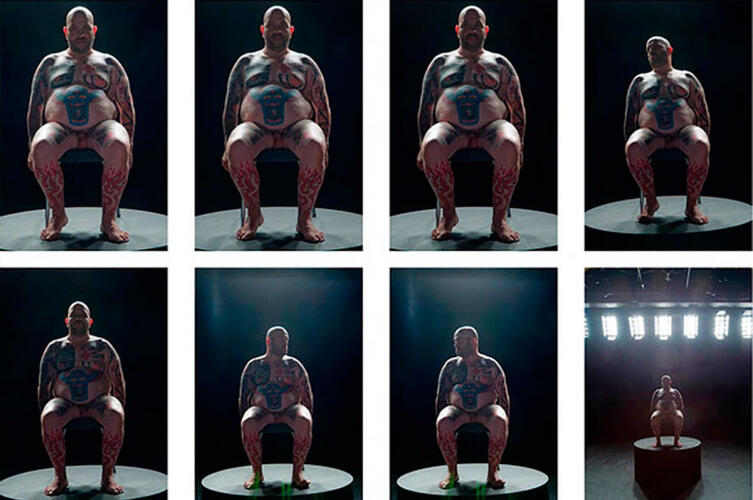
Don't Leave Me This Way marks a change in Franko B's performance practice, formalising his departure from blood-based work into the realm of the metaphorical. Here he allows the viewer time to look at his naked body and approach it as a sculptural form, heavily tattooed and scarred, voluptuous in shape and size, either as part of a collective audience or in a one-to-one encounter. Co-created with lighting designer Kamal Ackarie, lighting techniques mimic the effect that Franko's bleeding body has on audience members, while opening up a new range of emotional and bodily responses. Franko B's work leaves metaphorical marks on the psyches of vulnerable spectators, moving empathetic viewers with the visceral charge of the prone body.
MILK AND BLOOD
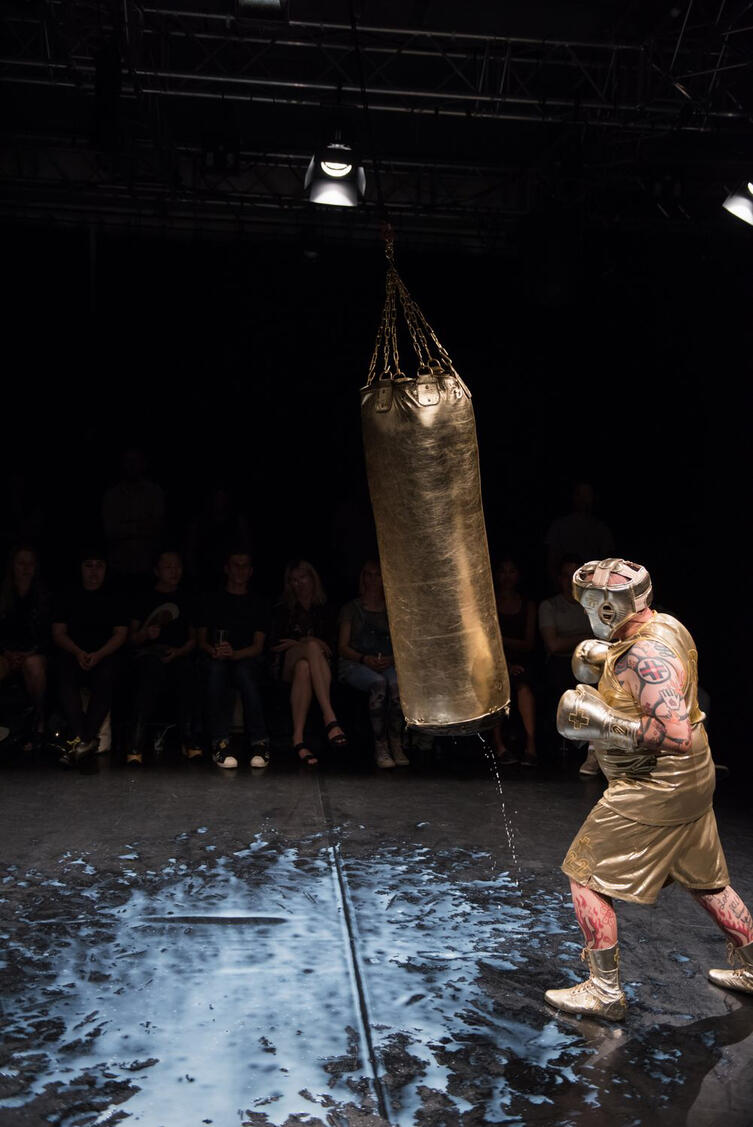
“I have language on my side” is one of the recurring sentences, – to my ears, the loudest of the words – that Franko B repeats during his last performance Milk & Blood.Assuming the posture and behaviour of a boxer, he hits a punching bag for multiple rounds, which unfold in a clockwise movement. During each break, an assistant gives him water and dries his forehead off of the sweat, checking whether all is fine. Franko is wearing a golden jumpsuit, the same as his shoes, boxing gloves and helmet are. Golden is also the punching bag facing him, full with milk, which gradually comes out at each kick or punch, fast invading the floor. A religious silence in the room contrasts the otherwise chaotic atmosphere of a usual boxing match, where the crowd screams in support of their champion. Where is the blood?On the 29th of July 2015, Franko performed Milk & Blood for the first time to the public, in the Toynbee Studios, London. The most striking element, in this battle of endurance and survival, was the loneliness on the stage; nobody else there to compete against, only a man with his words. Incessantly echoing a series of epithets and verbs, a reminder to the world of discrimination, judgement and sufferance, as well as to the political and poetic, Franko B uses his body once again as an instrument and canvas to fight away visible ghosts of the everyday.
I MISS YOU
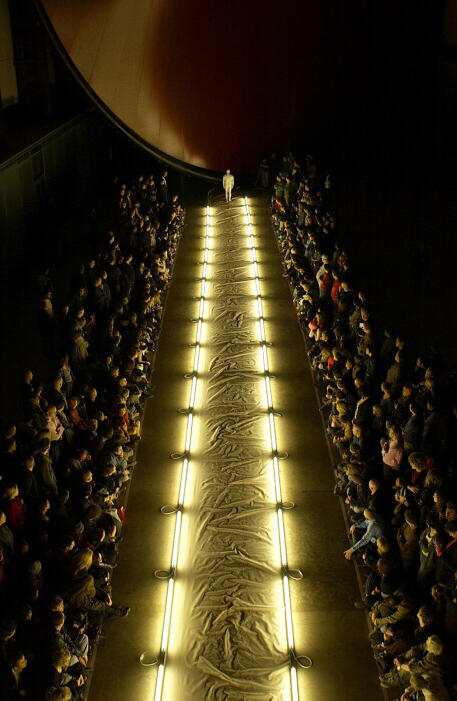
I Miss You was performed in silence, with only the sounds of the paparazzi’s camera flashes audible. The simplicity of the performance magnified the attention paid to Franko B’s body, from his heaving chest to the bounce of his exposed genitals, the creasing of his paint-encrusted skin to the subtle clenching of his fists to increase blood flow. According to first-hand accounts the challenging nature of I Miss You left many audience members in tears, with writer and critic Jennifer Doyle noting that the work engaged ‘the radical intimacy that sometimes attends to live art, which cannot be fully read without an account of its appeal to its audience and the invitation to experience it as, on some level, about our investment in the artist’. Indeed, though separated from Franko B by the border of the catwalk, the close proximity of the audience to the performer undoubtedly produced a connection which, while voyeuristic, was also highly empathetic. While assuming the likeness of a sterile and highly controlled catwalk show, Franco B – naked and pierced – provided a rare confrontation with the human body enduring pain.
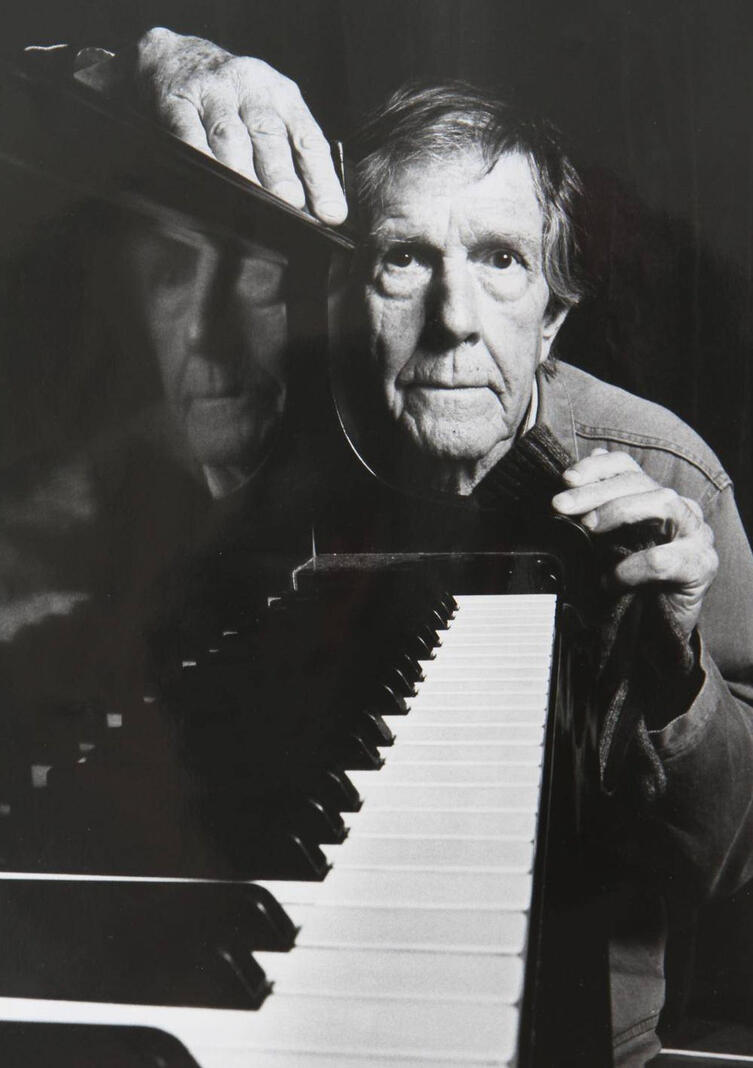
JOHN CAGE
A composer who blurred the lines between traditional music and performance art became one of the most influential avant-garde creators of the 20th century, composing sounds using new rhythms, unconventional instruments and redefining the meaning of sound and its relation to silence. After studying many varying creative disciplines, he became invested in music composition, ultimately using the skills he had learnt to write music that had never been heard before and performances not yet accepted by audiences. Cage was fully immersed in the art world, forming connections with prominent figures such as Marcel Duchamp, Max Ernst, Piet Mondrian and Jackson Pollock.
4’33” (Four Minutes and Thirty-Three Seconds) - 1952
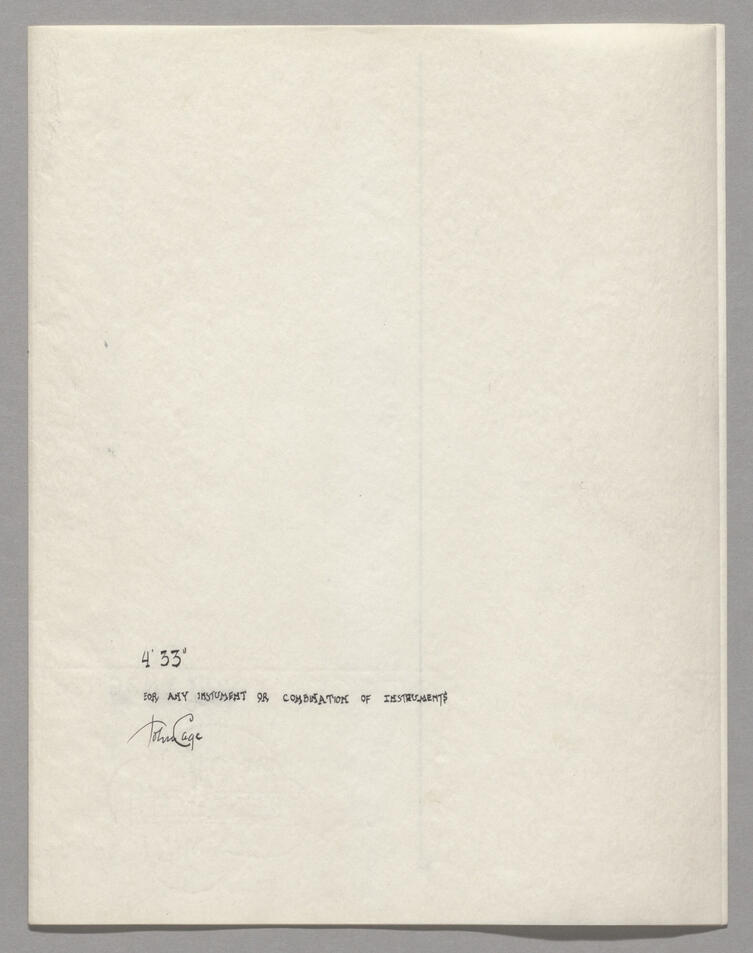
Cage’s best-known piece; a piece which entails the performer to sit at a piano in silence for the said duration, opening and closing the lid in small intervals. The concept raised a question; does true silence exist? While the performer sat still on the piano stool, the audience were presented with the sounds they ignore, the unconscious noises of chairs squeaking, people coughing, birds singing. Through listening to nothing, we are forced to hear everything.
Some audience members became angry at the performer on debut and left before it finished. Perhaps out of confusion or the feeling of uneasiness, their own silence imposed on them. Others regard this piece to be one of great influence on the future of sound artistry and immense importance to the post-war avant-garde.
‘Water Walk’ - 1960
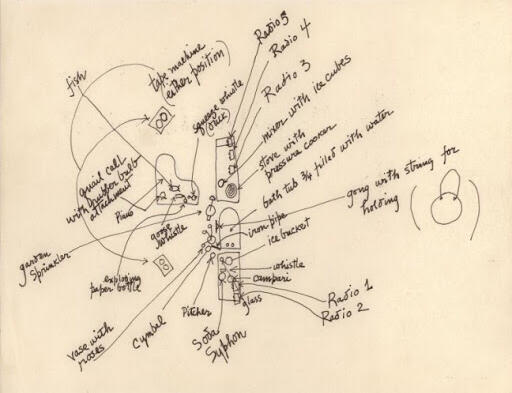
Debuted on a 60s television show (‘I’ve Got a Secret’), John Cage arranged a number of objects all relating to water, including a bath, a kettle and ice cubes, as well as traditional instruments such as a piano and cymbals. Cage may appear to use all these items randomly, but he had composed it cleverly to sound that way. Zen Buddhism, which Cage had studied, expresses the idea of music being a singular natural process, and not purely the notes chosen by the composer. With that in mind, he believed that all sounds, whether purposeful or not, are all music. Therefore, the idea of ‘instruments’ do not exist. As the performance began, the audience was confused but quickly erupted into nervous laughter. However, it was to be expected – as an avant-garde piece – to be met with differing responses.
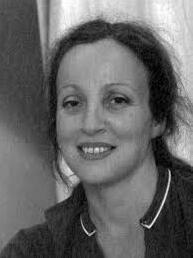
MANTALINA PSOMA
She was born in Athens but moved to Berlin to study at the Hochschule der Kuenste Berlin from 1985 to 1922. She got her bachelors in 1991 and her masters in 1922 and after had many pieces of her work in gallery’s across Greece. She returned back to Athens in 2001 to create more work that had a more personal connection to her. Her work is known for being almost cinematic and an eerily realist but also unrealistic pieces of work. Most of her work gives of a semantic atmosphere as it has overcasting shadows and is burdened with dark hues throughout her work, but is furthermore this semantic atmosphere as the almost realistic cartoon like portraits give of this creepy sinister appearance.Overall Matalina Psoma’s work gives of contrasting atmospheres by using contradicting colours and using realistic photos to work from but giving her portraits this unharnessed almost cartoon like appearance, which in return gives this unconventional appearance and leaves the viewers with ,iced reviews as they are thinking of so many contrasting thoughts and no clear description is giving leaving them in this mind blur or confusion, which is why her work is so unconventional and unsettling.
MIDDLE DAUGHTER
2013, oil on canvas, 110-150cm
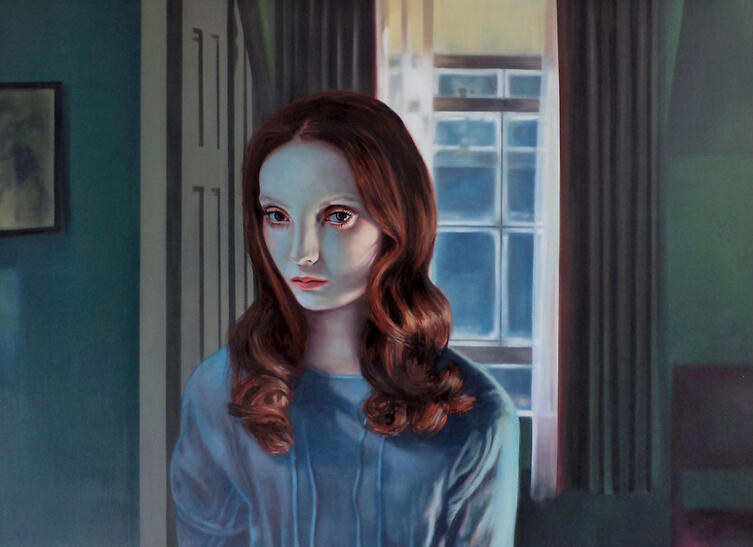
In ‘middle daughter’ Mantalina Psoma paints this almost realist while still being unrealistic portrait.The use of oil on canvas gives this smooth appearance to make the skin almost have this porcelain effect adding to this doll like nature giving it this sinister, creepy atmosphere.Her use of a realistic photo that she uses as a reference for her work but then paints in her style gives it this almost inhuman like appearance as although there is the clear facial features they have been adapted into her style to make the eyes appear larger and more deep set to almost widen them and give this piercing appearance as if they staring right at you .Her work also has this Tim Burton inspired appearance with the over-exaggerated features, added with her use of colour gives this striking appearance as the auburn hair contrasts with the ocean pale blue shirt drawing the viewers attention to the inhuman like facial features.All of these aspects added together makes this piece striking and quite unconventional as it gives this unsettling atmosphere as it’s almost to cartoon like while being realistic and the colours are almost bright like a cartoon but the depth of tone within them gives this realistic appearance.This divided her viewers as it gave of this piercing appearance that’s so drastically different from traditional portraiture as it has a darker overcast and sister appearance that contrast with the vibrancy of colours giving mixed emotions and feelings about the piece.
YOU SHOULDN’T FORGET
2011, oil on canvas, 130-200cm
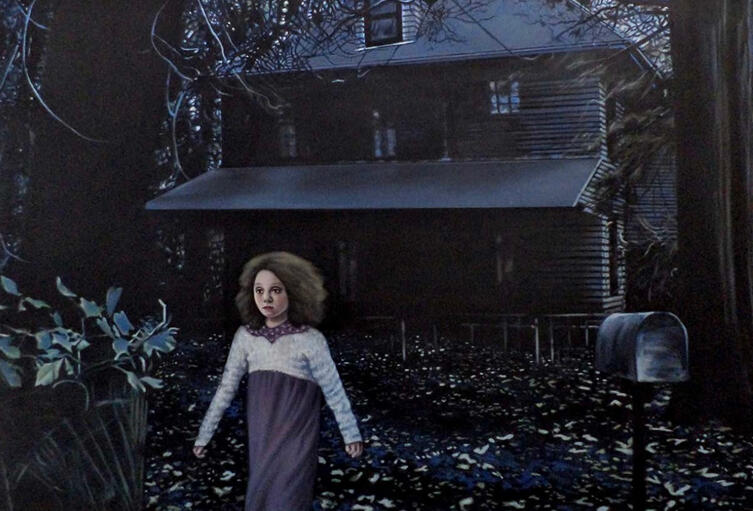
This piece of work furthermore adds to her sinister appearance of work as again her use of imagery and colour choice gives of mixed emotions that divided viewers as they where unclear on what to think.Her use of vibrant indigos and violets in the little girl are drastically different from the deep set blues in the house and woods.Her choice of positioning of the imagery is also smart as the little girl is in the foreground the use of these vibrant colours makes her ascend further out giving this almost disassociated appearance from the house as the house receded into the background so the little girl appears further forward or as if she was stuck on as she is drastically brighter than her background.Again her use of Imagery is also very clever as mixed with the dark set shadows the house appears old and crooked adding to this malicious almost devil like appearance.Having the imagery of the house surrounded by the woods almost being encased or trapped makes you scared for the little girl as it suggest she is too trapped with nowhere to go.However I also think she links her imagery as the girls hair is chaotic like the leaves and forest giving more clarity to the piece but also gives this contrasting atmosphere as it gives of a relaxing atmosphere as the connection suggests it might be her home and that’s she’s safe there but the dark shadows suggest a horror sinister atmosphere.This work also further divided viewers as again they where not sure what to think, to be scared or not as they didn’t know who the little girl was, and her lack of expression also made it more confusing as it was harder to think of her connection to the house.